
Soybean Planting guides
IEagle Seed has spent over 50 years breeding the industry’s leading forage soybeans. This page provides complete planting guidance for forage soybeans, wildlife soybeans, and high‑tonnage soybean varieties. Learn how nodes, leaf size, maturity, and planting timing affect yield, browse tolerance, and pod production.
Soybean Planting Video
FAQs
- What Is a Forage Soybean?
- A forage soybean is a soybean bred specifically for maximum vegetative growth, producing far more nodes, branches, leaves, leaf area, protein, and sugar than standard agricultural soybeans. Forage soybeans stay in the vegetative stage longer, creating high‑tonnage, high‑nutrition forage for cattle, haylage, silage, and wildlife.
- A forage soybean is a soybean bred specifically for maximum vegetative growth, producing far more nodes, branches, leaves, leaf area, protein, and sugar than standard agricultural soybeans. Forage soybeans stay in the vegetative stage longer, creating high‑tonnage, high‑nutrition forage for cattle, haylage, silage, and wildlife.
- How are forage soybeans different from regular soybeans?
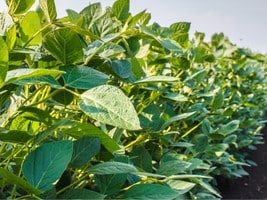
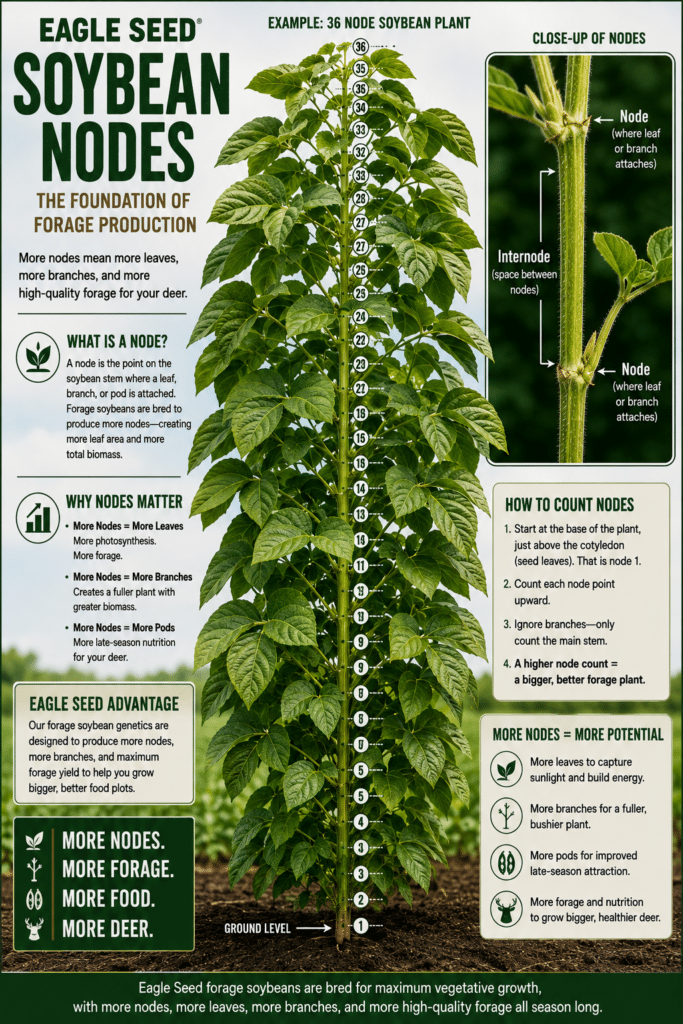
Regular soybeans typically produce 18–22 nodes and focus their energy on grain production. Even if they are a tall variety, they won’t have more leaves. True forage soybeans such as Big Fellow or Large Lad can produce up to 36 nodes, resulting in twice as many branches and leaves. They also develop much larger leaves—up to 3× the size of agricultural soybean leaves—and contain higher sucrose and protein, with leaf protein documented up to 42%. Not every soybean can be a forage soybean.
- What is the difference between a forage soybean and a crop soybean?
- Tonnage is the main difference between the two types of soybeans. In Southern Illinois University research, Eagle Seed soybeans could produce up to 10 tons of food per acre. That was 3 times the tonnage of the ag bean in the same trial.
- Eagle Seed Forage soybeans are special. Several of them are an unusual twist of nature. Late maturing with indeterminate growth habit is very rare. Indeterminant growth habit means it puts on new leaves on older areas of the plant. Indeterminate growth and superior plant architecture are required for forage soybeans to keep up with grazing by animals. In many cases where deer are heavily browsing a later maturing soybean is used; however, those are usually determinate and do not continue to grow as rapidly when browsed.
- Tonnage is the main difference between the two types of soybeans. In Southern Illinois University research, Eagle Seed soybeans could produce up to 10 tons of food per acre. That was 3 times the tonnage of the ag bean in the same trial.
- What makes Eagle Seed the authority on forage soybeans?
- Eagle Seed has spent over 50 years breeding, selecting, and improving forage soybean genetics. This is the longest‑running forage soybean breeding program in the United States, and no other company has that depth of research, data, or experience. Eagle Seed developed industry‑leading varieties such as Big Fellow® and Large Lad®, used by universities, cattle producers, and wildlife managers nationwide. It also introduced the first ever multifoliate forage soybean – MultiMax®, Forage Flex® the first ever XtendFlex® forage soybean, and Plot Envy® the first ever Enlist® Forage Soybean.
- Are forage soybeans good for cattle and haylage?
- Yes. Forage soybeans provide high protein, high sugar, and high digestibility, making them ideal for cattle forage, haylage, and silage. Their extended vegetative growth and large biomass create a reliable, nutrient‑dense feed source.
- Do forage soybeans benefit wildlife?
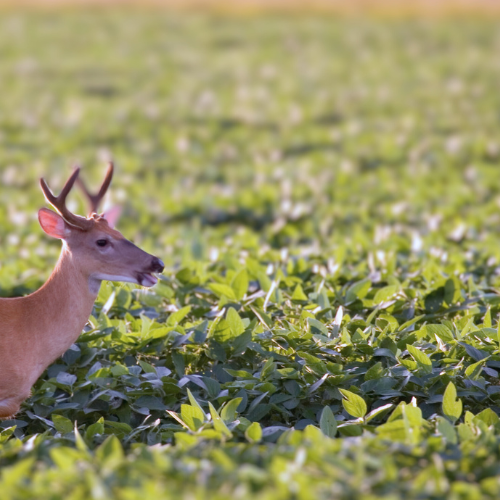
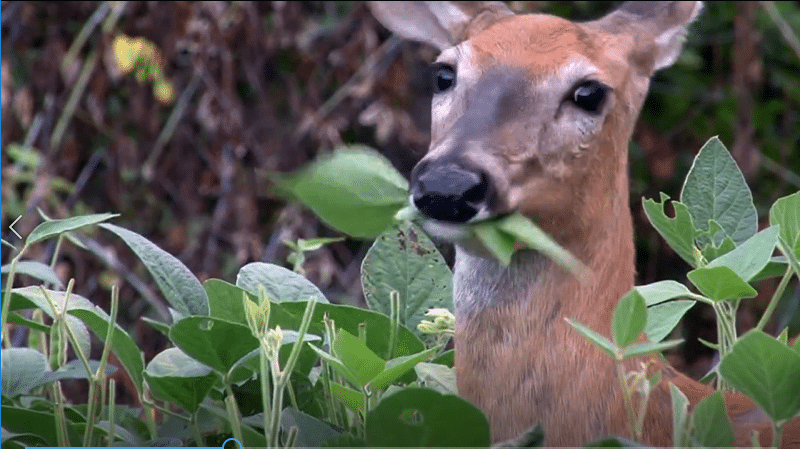
- Absolutely. Forage soybeans produce abundant, high‑quality forage throughout the growing season. Their extended growth period and large leaf mass provide consistent food for deer and other wildlife, supporting antler growth, lactation, and overall herd health.
- Best Soybeans for Deer
- If you are in the Deep south – GameKeeper is the best forage soybean for deer. For the rest of the country it is Wildlife Manager’s Mix. If you have developed weed issues, then the recommendation can change to Plot Envy or Forage Flex depending on your weeds.
- Best Soybeans for Heavy Deer Pressure
- In testing by Mississippi State University and through the Soybean Science Challenge, MultiMax and GameKeeper perform the best. Large Lad and Big Fellow are also excellent.
- How Many Acres Do I Need?
- We recommend a minimum of 2 continuous acres. If you know you have heavy deer pressure, then you will try for 5 or more continuous acres for best results. High fence areas with extreme deer density will even try to plant 40% of their summer crop to soybean.
- How Many Seeds Per Acre?
- Try to plant a minimum of 140,000 seeds per acre. Research shows that in heavy deer populations, up to 250,000 seeds per acre can be used.
- How Late Can I Plant?
- It depends on the part of the country where you live. However, we have customers who will plant our soybeans as a quick attractant in the fall. For maximum production of the forage soybean, you will want to plant after your last spring frost when your soil temperature is above 62 degrees at a one inch depth. Planting earlier tends to increase seed production and root development prior to drought.
- How long do forage soybeans stay green?
- Most forage soybeans are bred for longer maturity, meaning they stay green and productive much longer than agricultural soybeans. In the early days of forage extended vegetative period is a key reason they produce more tonnage and remain attractive to wildlife later into the season.
- Will Forage Soybeans Make Pods?
- Eagle Seed Big Fellow and Large Lad produce excellent pods and have produced as much as 60 bushels per acre in Virginia Tech testing. This was under browse pressure. Wildlife Manager’s Mix has been created in 3 different maturities to plant in various regions of the country Just make sure to select the correct variety based on your region for best results. We provide an easy to read map here What’s Right For Me? – Eagle Seed, LLC. Our new XtendFlex and Enlist varieties also produce excellent pods – as good as most agricultural lines. Additionally, Pod Haven is built for pod production and features 3 maturities in one bag.
- Which Maturity of Forage Soybean Should I Plant?
- Just make sure to select the correct variety based on your region for best results. We provide an easy to read map here What’s Right For Me? – Eagle Seed, LLC.
- How Do I Manage Heavy Deer Pressure on Soybean?
- Three things are key, plant enough seed per acre, plant enough acres and plant on time. If you plant late, you are introducing issues with moisture and soil temperatures. Lastly, use a deer deterrent for the first 6-8 weeks. Milorganite is popular, but a double-stranded deer fence is the most effective.